
San Diego County Sex Offender Checks
The California Megan's Law Website is the first public channel for a San Diego County sex offender lookup. The California Department of Justice manages the underlying California Sex Offender Registry and publishes only the records and fields that Penal Code section 290.46 permits. It is free to use. A visitor must read and accept the site's disclaimer before reaching the search. The public site is not a complete list of every person who has a duty to register, so the absence of a public profile does not prove that no registration duty exists.
Start with a full name when one is known. For community awareness, use the official place-based routes described by the site, such as a city, ZIP code, address, or map/list view. Match more than a name. Compare the photo, aliases, physical description, location category, and offense information before reaching any conclusion. DOJ says local agencies submit updates and the public system is updated daily, but a recent move or status change may still be working through the local reporting process.
San Diego Registry Disclaimer
The Megan's Law entry screen matters. It explains that public information is supplied for protection, identifies legal limits, and warns that the database may not show every registrant. The visitor must accept those conditions before searching. That pause is useful because a registry result is a public-safety record, not a general character report. It should not be treated as proof of conduct beyond the disclosed conviction and registration facts.
The disclaimer also bars a registered sex offender from using the search function. Penal Code section 290.46(i) provides a potential fine of up to $1,000, up to six months in county jail, or both for that prohibited access. Other visitors should still use the narrow purpose DOJ states: awareness and safety planning. Save the profile details needed to confirm a possible match, then contact the agency that maintains the record if a material fact appears wrong.
The official California Megan's Law entry screen shows the conditions that precede every public search.
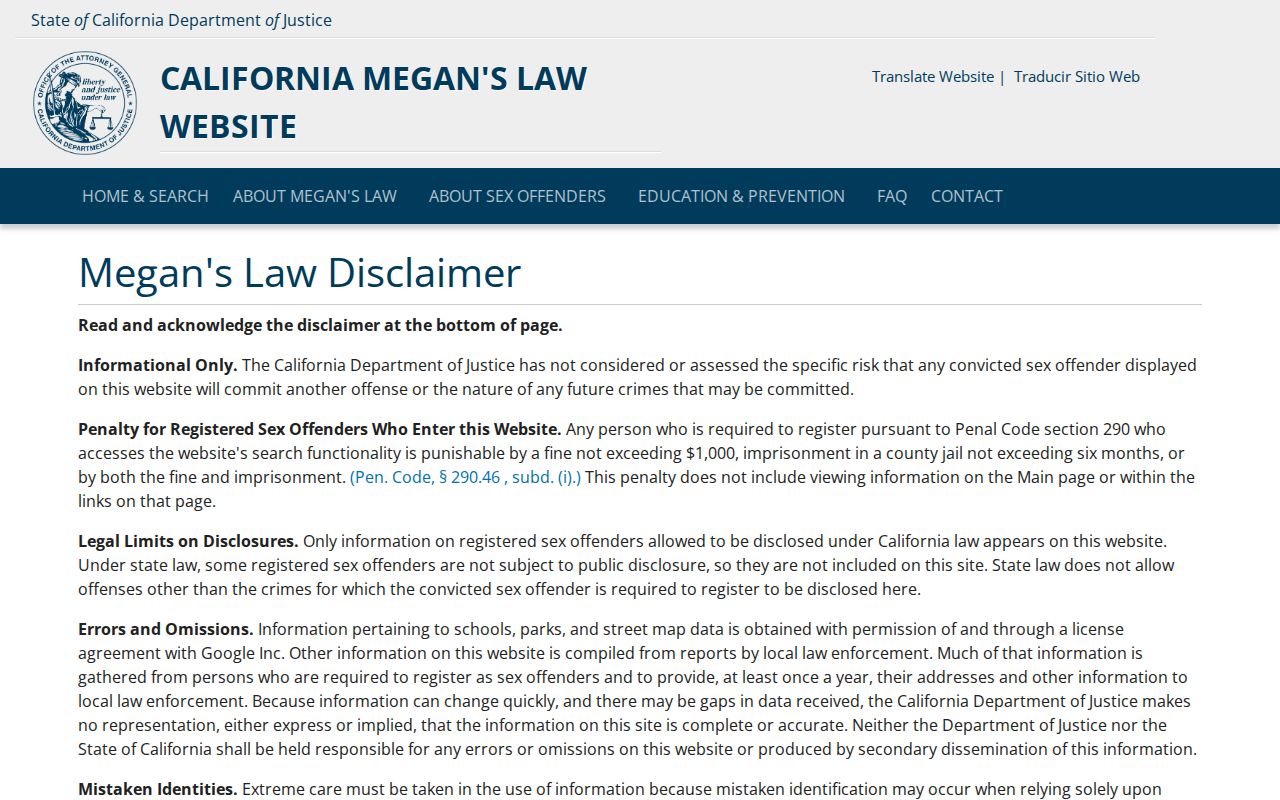
Reading those terms first helps keep a San Diego County lookup focused on identification, awareness, and lawful safety decisions.
California Megan's Law Searches
California Megan's Law provides the official public search layer for San Diego County. Search routes described by official sources include a person's name and location-based tools using a city, ZIP code, address, or map/list view. Exact interface choices can change, so follow the labels shown after accepting the disclaimer rather than assuming that a fixed distance option is always available.
- Open California Megan's Law and read the conditions of use.
- Accept the disclaimer, then choose a name or place-based search.
- Review possible results and compare several identifying fields.
- Open the profile and note its address category, offense, and registration status.
| Field Label | Type | Required | Notes |
|---|---|---|---|
| Name | Text | For name search | Use the known name, then verify aliases and physical details. |
| City or ZIP | Text or select | For place search | Narrows the public results to a community. |
| Address | Text | For address search | Use the location tools displayed by the current interface. |
| Map or list | Map/list | No | Provides a place-based view where the official interface offers it. |
San Diego Cross-State Registry Checks
The Dru Sjodin National Sex Offender Public Website adds a national layer when a search may cross California's border. NSOPW can search participating jurisdictions by name and offers place fields such as county, city or town, and ZIP code. That makes it useful when a person recently moved, travels between states, or when the relevant jurisdiction is unclear.
NSOPW does not replace California's source record. Open a linked California result and read the state's own profile and use terms. The national portal gathers public registry information from many jurisdictions, while California controls which California fields are disclosed and how often its source data changes. For a San Diego County record, local correction and registration questions still go to the responsible police department, Sheriff's Office, or California DOJ.
The official NSOPW search is illustrated below.
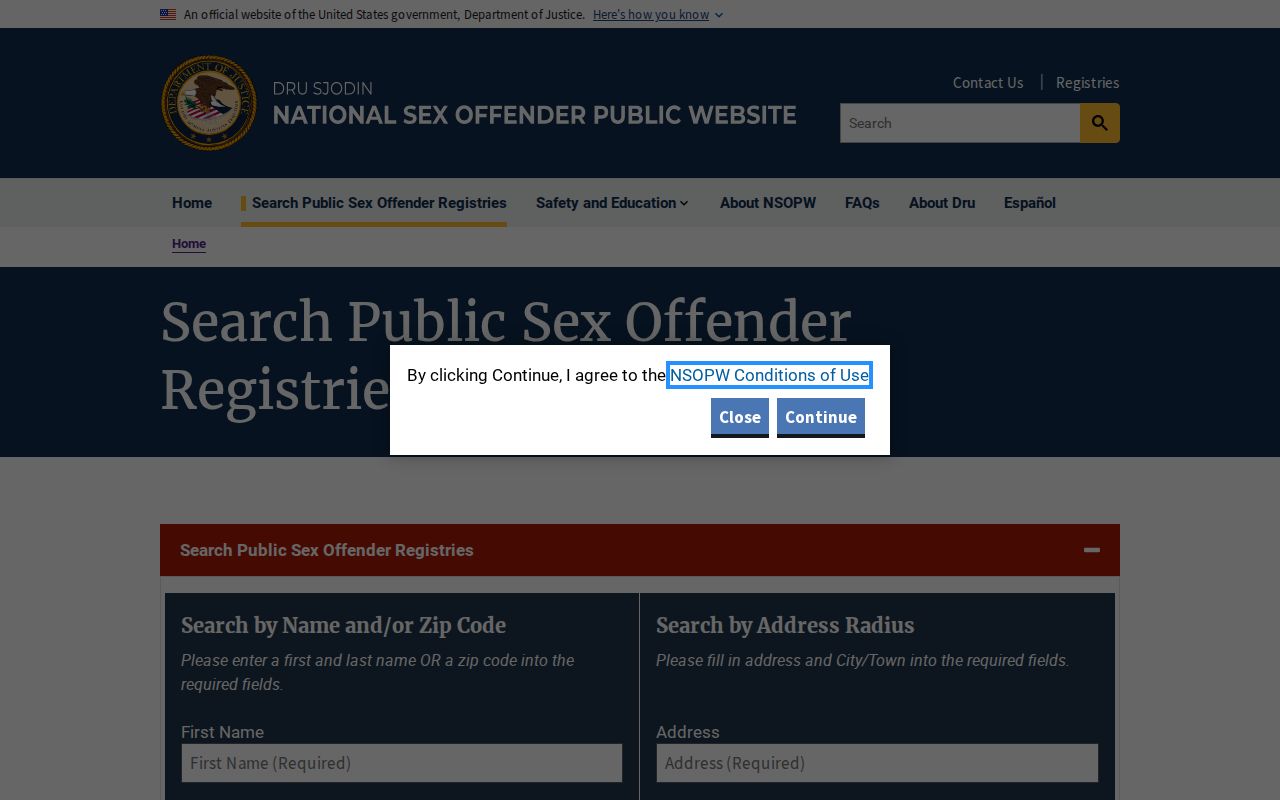
Its wider reach is helpful, but the originating California profile remains the best place to confirm a San Diego County listing.
Registry Profiles: What They Show
A public profile combines identifiers, conviction information, and registration data. The exact address display varies by the person's disclosure category. A profile may show a full home address, a conditional address, or only ZIP, city, and county information. Some people with a legal duty to register are excluded from public display. Those limits are part of California law, not a sign that the local agency has no record.
| Name & Aliases | Legal name and aliases released for public identification. |
|---|---|
| Photo & Physical Description | Photograph and identifying traits, which may include scars, marks, or tattoos. |
| Registered Address | Full address or a more limited location category, depending on disclosure law. |
| Offense & Statute | Offenses requiring registration and related conviction or code information. |
| Tier Information | Public tier or risk-related information when California permits disclosure. |
| Registration Status | Status information, including a violation flag when publicly displayed. |
Hidden San Diego Registry Records
One of the easiest mistakes is to equate the public website with the full California Sex Offender Registry. They are not the same. DOJ maintains the registration database, but Penal Code section 290.46 controls which registrants and facts the public site may display. A person may still have an active local registration duty even when a name search produces no public profile.
This distinction affects both safety and accuracy. Try a careful name search, account for aliases, and use a location search when appropriate. Do not infer that a person has failed to register merely because a profile is hard to find. Questions about an apparent omission belong with the local registration agency or DOJ. Corrections may be sent to the police or Sheriff's Office that reports the information, or to MegansLaw@doj.ca.gov.
Registration Levels and Duties in California
California's tier system sets minimum registration periods for adults. Tier 1 generally carries a 10-year minimum, Tier 2 a 20-year minimum, and Tier 3 a lifetime duty. Juvenile minimums differ: five years for Tier 1 and ten years for Tier 2. A minimum period does not mean the name disappears on that date. Eligible people generally must petition for termination, and the applicable court and agencies review the request.
| Level / Tier | Duration | Verification Frequency |
|---|---|---|
| Tier 1 adult | 10-year minimum | Annual update, plus event-based updates |
| Tier 2 adult | 20-year minimum | Annual update, plus event-based updates |
| Tier 3 adult | Lifetime | Annual or more frequent updates when required |
| Transient registrant | While duty applies | Every 30 days |
| Sexually violent predator | As required by law | Every 90 days |
San Diego Registration at Ridgehaven
The San Diego County Sheriff's License and Criminal Registration Division handles Penal Code section 290 registration for people within Sheriff's jurisdiction. The office is at 9621 Ridgehaven Court, San Diego, CA 92123. Its Criminal Registration line is 858-974-2822, and its general division line is 858-974-2020. Mail goes to P.O. Box 939062, San Diego, CA 92193-9062. The listed email is crm.licensing@sdsheriff.gov.
Timing is unusually specific. Walk-in registration is limited to Tuesdays and Wednesdays. Thursday morning service is by appointment. The lobby closes and phones switch to a recording from noon to 1:00 p.m. Visitors must sign in by 11:00 a.m. for morning help or by 3:00 p.m. for afternoon help. City residents may register with the police agency that has jurisdiction instead. For example, San Diego Police operates its own Sex Offender Registration Unit.
The desk also accepts requests for tier notification letters. A person who needs a letter should use the Sheriff's published registration channel rather than relying on a public profile to establish a private legal duty. International Megan's Law travel forms must reach the office 21 days before departure.
San Diego Registry Update Clocks
Registration is not a one-time event. California's summary requires initial registration and address-change reporting within five working days. The annual update falls within five working days before or after the person's birthday. Some registrants face shorter cycles, including 30-day updates for transient registrants and 90-day updates for sexually violent predators.
Local law enforcement sends updates to DOJ, and DOJ states that the public Megan's Law data is updated daily. Those two clocks explain why a just-reported change may not appear at the same moment on every screen. A resident who sees a stale address should avoid direct contact. Send the suspected error to the local registration agency or DOJ so the custodian can check it.
San Diego SAFE Task Force
San Diego County uses a regional Sexual Assault Felony Enforcement, or SAFE, Task Force to monitor and enforce registration laws. The District Attorney's public material estimates that about 4,500 known sex registrants are in the county at any given time. That figure gives context to the scale of local registration work, but it should not be read as the number of public profiles or as a fixed daily count.
The SAFE Task Force also receives public comments concerning sexually violent predator placement. The listed channels are sdsafe@sdsheriff.org, 858-583-7238, and mail to SVP Release/SAFE Task Force, 9425 Chesapeake Drive, San Diego, CA 92123. These channels serve comments and enforcement-related concerns. Emergencies or immediate threats still belong with 911, not a registry search or email queue.
Using Registry Information Lawfully
Registry information supports public protection, neighborhood awareness, and practical family safety plans. A careful response may include confirming a profile through the official site, discussing age-appropriate boundaries with family members, and using the proper law-enforcement channel for a suspected violation. It does not include confrontation, publication of private family details, or punishment outside the justice system.
Penal Code section 290.46(j) permits criminal prosecution and civil liability when registry information is used to commit a crime or to harass a registrant or the registrant's family. The law also limits discriminatory uses. Public access does not grant permission to threaten, intimidate, stalk, or organize vigilante action. When a profile seems inaccurate, report it. When conduct creates an immediate risk, contact law enforcement.
Misuse is a crime: California Penal Code section 290.46 forbids using registry data to commit a crime or harass a registrant or family, and misuse may create criminal and civil liability.