
San Diego Criminal History Checks
Choose the source by record stage. The San Diego Police Department report service is the direct route to an SDPD incident or releasable arrest report. A public-record request reaches a broader set of non-exempt city documents. The Sheriff supplies current custody data after county intake. The Superior Court supplies the case index and court file once prosecutors file charges. These records overlap, but none replaces all the others.
Use this order to reduce false matches and missed files:
- Gather the incident date, location, parties, and SDPD report number if known.
- Ask SDPD for the report or use its public-record portal for other city records.
- Check the Sheriff’s Who’s In Jail search if the person may still be in custody.
- Search the Superior Court Court Index for a filed criminal or minor-offense case.
- Use California Live Scan only to review your own DOJ criminal-history summary.
San Diego Police Records Desk
SDPD’s Records Division works from 1401 Broadway, San Diego, CA 92101. Its public counter is open Monday through Thursday from 7:30 a.m. to 3:30 p.m. Mail requests go to SDPD Records MS#726, P.O. Box 121431, San Diego, CA 92112. After seven business days, requesters may check readiness at sdpdreportrequests@pd.sandiego.gov or 619-531-2846. Those channels matter because SDPD does not treat every police document as an open online file.
A useful request identifies the date, place, and type of event as well as the involved parties and report number. The agency determines whether the requester is entitled to a copy and whether protected details must be removed. Arrested persons and suspects do not receive police reports directly under SDPD’s stated policy. Their legal representatives use criminal discovery or a subpoena. That rule can explain why a routine counter request fails even when the requester knows the report exists.
Records at San Diego Police
SDPD holds reports created by its officers, including incident, arrest, and collision records. It is not the holder of the later Superior Court case file or the county jail’s live custody record. A report describes what officers received, saw, and recorded at that stage. A filed case reflects the prosecutor’s charge decision and the court’s later actions. Keeping those sources apart prevents a city report from being read as a final finding.
Most report copies cost $12. An arrest report is limited to releasable page 1 and costs 50 cents. Checks and money orders are payable to the City Treasurer. Traffic collision requests usually need three to ten business days before processing and release. Fees and release rules should be confirmed on the official page before mailing payment because the city controls the source record and its current procedure.
| Custodian | SDPD Records Division |
|---|---|
| Core records | Police, incident, arrest, and collision reports |
| Request paths | Records counter, mail, email or phone follow-up |
| Arrest copy | Releasable page 1 only under SDPD policy |
| Later case | Superior Court, not SDPD |
San Diego NextRequest Records
The SDPD public-records page routes broader California Public Records Act requests through NextRequest. This channel fits non-exempt city records such as policies, correspondence, or data that are not handled as a standard report-copy order. Describe the record, date range, office, and subject with enough detail for staff to locate it. A broad demand may take more clarification than a focused request.
The official SDPD source below shows the public-record request route and its connection to the NextRequest portal.
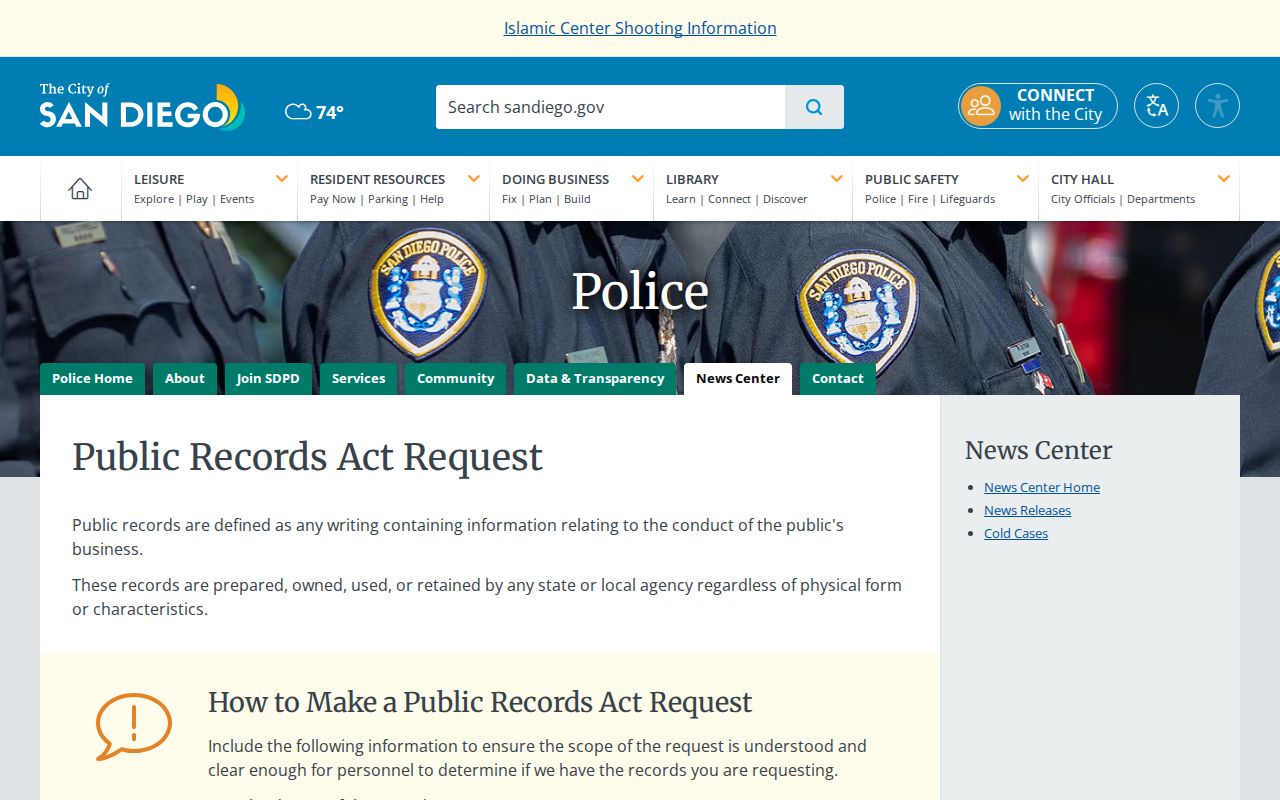
That portal handles broader public records, while the report-copy process remains the direct route for a specific police report.
San Diego permits an anonymous request. The tradeoff is practical: an anonymous requester cannot receive updates or clarification notices and must return to the portal to check posted responses. SDPD may redact juvenile data, protected sex-crime victim information, confidential-informant details, criminal offender record information, safety-sensitive witness data, or material whose release could harm an investigation or proceeding. A redaction does not mean the whole record is missing.
Booking and Arrest Records in San Diego
SDPD creates the arrest report when its officers make an arrest, but county detention staff create and maintain the jail record after intake. San Diego city arrestees are generally booked into Sheriff facilities. San Diego Central Jail often receives male arrestees downtown, subject to classification and intake decisions. The official Who’s In Jail search is the better source for current custody status.
The jail result is not a city criminal-history report. It is a time-sensitive custody entry. Release, transfer, or data timing can change what appears. The SDPD report may remain at the city even after the person leaves custody. If charges are filed, the court case becomes a third source. For deeper county booking context, the dedicated San Diego County arrest search explains the custody and report channels without turning an arrest into proof of guilt.
San Diego Collision Report Requests
Traffic collision records follow a distinct SDPD route. The city directs online requests through LexisNexis eCrash, and the documented phone channel is 866-215-2771, Monday through Thursday from 8 a.m. to 8 p.m. Eastern. SDPD advises allowing three to ten business days for a collision report to be processed and released. A request made too soon may fail because the report is not ready, not because no event occurred.
Use the collision date, location, involved parties, and report number when known. Access can depend on the requester’s relationship to the crash, and protected information may be withheld. Vehicle Code section 20012 also limits access to certain collision reports. This narrower process is why a broad city public-record request is not always the best first step for a crash file.
The San Diego Municipal Court File
San Diego no longer operates a separate municipal criminal court in the old sense. The Superior Court of California, County of San Diego handles these matters. Its Traffic/Minor Offense Division covers Vehicle Code cases, some city ordinance violations, infractions, and minor misdemeanors. The Kearny Mesa Branch at 8950 Clairemont Mesa Boulevard handles traffic functions, while criminal cases may route to the Central Courthouse.
Search the Court Index to locate a case number and filing location. Then request the file from the courthouse that holds it. Court rules may limit remote viewing even when an index entry is public.
| Court name | Superior Court of California, County of San Diego |
|---|---|
| City-level matters | Traffic, municipal ordinances, infractions, and minor misdemeanors |
| Lookup | San Diego Superior Court Court Index |
| Docket contents | Case number, parties, filing location, hearings, charges, and disposition when public |
| Copies | Requested from the filing courthouse, subject to access rules and fees |
San Diego Court Branch Choice
A city event does not guarantee that every related record sits at one downtown counter. Kearny Mesa handles traffic functions, and the Central Courthouse handles many criminal proceedings. The Court Index is useful because its location field tells a requester where the file was opened. A copy request sent to the wrong branch can add delay even when the case number is correct.
The public index is also not a full statewide rap sheet. It excludes some material, including juvenile matters and infractions under its disclaimer. Sealed and confidential files may require a court order. Use the case index as a locator, then rely on the clerk’s file for the charge, hearings, plea, disposition, and sentence.
How San Diego Records Reach the County
Each custodian records a different step. SDPD documents the event and arrest. Sheriff detention staff document county intake and custody. Prosecutors decide what charges to file, and the Superior Court records the case. Fingerprints and final disposition data may later feed California DOJ systems. That sequence is why a very recent event may exist at SDPD or the jail before it appears in a court or state record.
Record flow: San Diego Police Department › San Diego County Sheriff and Superior Court › California Department of Justice
For an older, fully processed matter, compare the court disposition with your own DOJ record review if accuracy is at issue. California DOJ does not offer a public name-based search of another person’s full state criminal history. County and city searches remain separate public access tools, not substitutes for the restricted DOJ rap sheet.
San Diego Arrest Report Limits
The city’s page-one rule is a key source limit. Paying 50 cents for an arrest report does not buy the full investigative file. SDPD states that only page 1 is releasable through this route. Other pages may contain material protected by investigative, privacy, victim, witness, or criminal-process rules. A requester should not infer that omitted pages never existed.
If a criminal case is underway, counsel obtains material through discovery rather than a public report-copy request. Once a case is filed, the court docket is the right place to check the public procedural history. The two channels answer different questions: the police page identifies the city arrest event, while the court file shows what was formally charged and how the case moved.
San Diego State Record Review
For a complete review of your own California criminal-history summary, use the California DOJ record-review process. It requires the record-review Live Scan form and fingerprint submission through a provider. Rolling fees vary by provider. This subject-only process can reveal state repository entries that a single San Diego city or county search cannot collect in one place.
It cannot be used as a public name search for someone else. If an entry appears wrong or lacks a disposition, compare it with the originating SDPD report and the Superior Court file before using DOJ’s correction procedure. City, county, and state files can update on different schedules.
San Diego Record Access Rules
Access depends on both the record type and the custodian. City administrative records start with the California Public Records Act, while police investigative files and state criminal-history information face added limits. Court records follow judicial access rules rather than the city’s NextRequest process. A focused request to the correct office is more effective than treating all San Diego criminal records as one public database.
Key statutes and rules:
California Public Records Act sets the general right to inspect city records and preserves exemptions.
Penal Code section 11105 restricts dissemination of California DOJ criminal-history information.
California Rules of Court, rule 2.503 limits remote public access to some electronic criminal court records.
Juvenile, sealed, victim, witness, and active-investigation material may be restricted even when another part of the file is public. Verify a record with the office that created it and use the formal review path when an entry concerns your own history.